HSC Maths Trigonometry: From the Unit Circle to Exam Questions
Trigonometry is the thread running through most of HSC maths. Functions, differentiation, integration, even vectors in Extension, they all lean on trig. Get comfortable here and a lot of later topics get easier.
The unit circle is everything
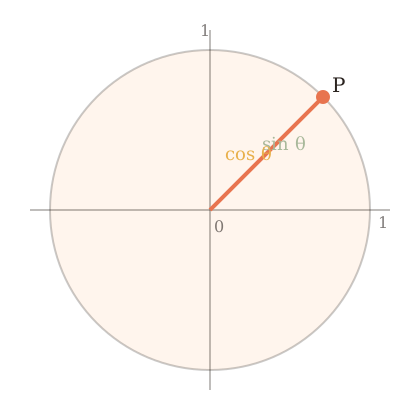
Skip memorising triangles. The unit circle (radius 1, centred at the origin) gives you every trig value.
- cos θ = the x-coordinate
- sin θ = the y-coordinate
Walk around the circle and you get the signs in each quadrant: All positive (1st), Sin positive (2nd), Tan positive (3rd), Cos positive (4th). "All Stations To Central" if that helps.
The exact values
You need sin, cos, tan for 0°, 30°, 45°, 60°, 90° without thinking. The ones that trip people:
A clean trick: sin values go √(0)/2, √(1)/2, √(2)/2, √(3)/2, √(4)/2 as the angle moves 0 to 90. Cos is the reverse.
Key identities
These turn up constantly:
In Extension 1 you add the compound angle formulas and the double-angle identities (sin 2θ = 2 sin θ cos θ, cos 2θ = cos²θ − sin²θ). Learn them early.
Solving trig equations
The trap: there's usually more than one solution in the given domain. Always sketch the unit circle or the graph.
Example: solve sin θ = 1/2 for 0° ≤ θ ≤ 360°.
From the circle, θ = 30° (1st quadrant) and θ = 150° (2nd quadrant, where sin is also positive). Two answers. Students who write only 30° lose the mark.
Trig in calculus
Differentiating sin x gives cos x. Integrating cos x gives sin x. The derivative of tan x is sec²x. These come up in motion, rates of change, and area problems. If your trig is shaky, calculus with trig becomes guesswork.
How to get good at it
Trig is pattern-heavy. Do mixed batches: one identities question, one equation, one graph sketch. The exam never tells you which tool to use, that's the skill.
The gist
Unit circle for values, identities for manipulation, sketch for equations. Get those straight and trig stops being the topic students fear.