HSC Maths Standard 2: Networks and Measurement Made Simple
Doing Standard 2? Two topics set you apart from the Advanced crowd: networks and measurement. They're practical, visual, and very learnable. Here's what NESA expects.
Networks basics
A network is a set of points (vertices) joined by lines (edges). You'll work with:
- Shortest path: find the path with the smallest total weight (Dijkstra's algorithm or systematic trial)
- Minimum spanning tree: connect all vertices with the least total weight (Kruskal's or Prim's)
- Critical path analysis: schedule a project, find the longest path through the tasks (the "critical" one)
Shortest path method
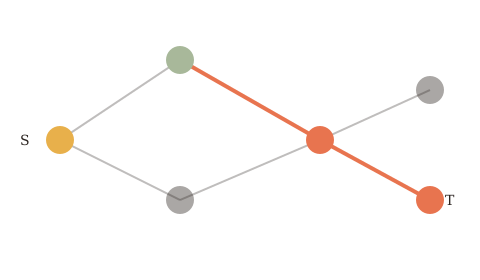
Label from the start, always extending the shortest known distance to a new vertex. Don't guess, be systematic or you'll miss a shorter route.
Critical path
Draw the network of tasks with their durations. The critical path is the longest chain from start to finish. Delay it and you delay the whole project. Float (slack) is how much a non-critical task can slip without pushing the finish back.
Measurement that gets tested
Standard 2 leans on applied measurement:
- Area and volume of composite shapes
- Surface area of prisms, cylinders, spheres
- Pythagoras and trig in real contexts (ramp angles, shadow lengths)
- Rates and ratios in practical problems
The trap is units. Convert everything to the same unit before calculating. A question mixing cm and m is testing whether you notice.
Why these earn marks
Network questions are often process marks. Follow the algorithm and you score. Some of the most reliable marks in the Standard 2 paper. Measurement is similar: formulaic, applied, predictable.
Practising the process
Because these are algorithmic, repetition is king. Do five shortest-path problems back to back and the method becomes automatic.
Drill networks and measurement with step-by-step solutions on PracticePapers.io, free during beta.
Takeaway
Networks and measurement reward process over insight. Learn the algorithms, watch your units, and these become the questions you're glad to see.