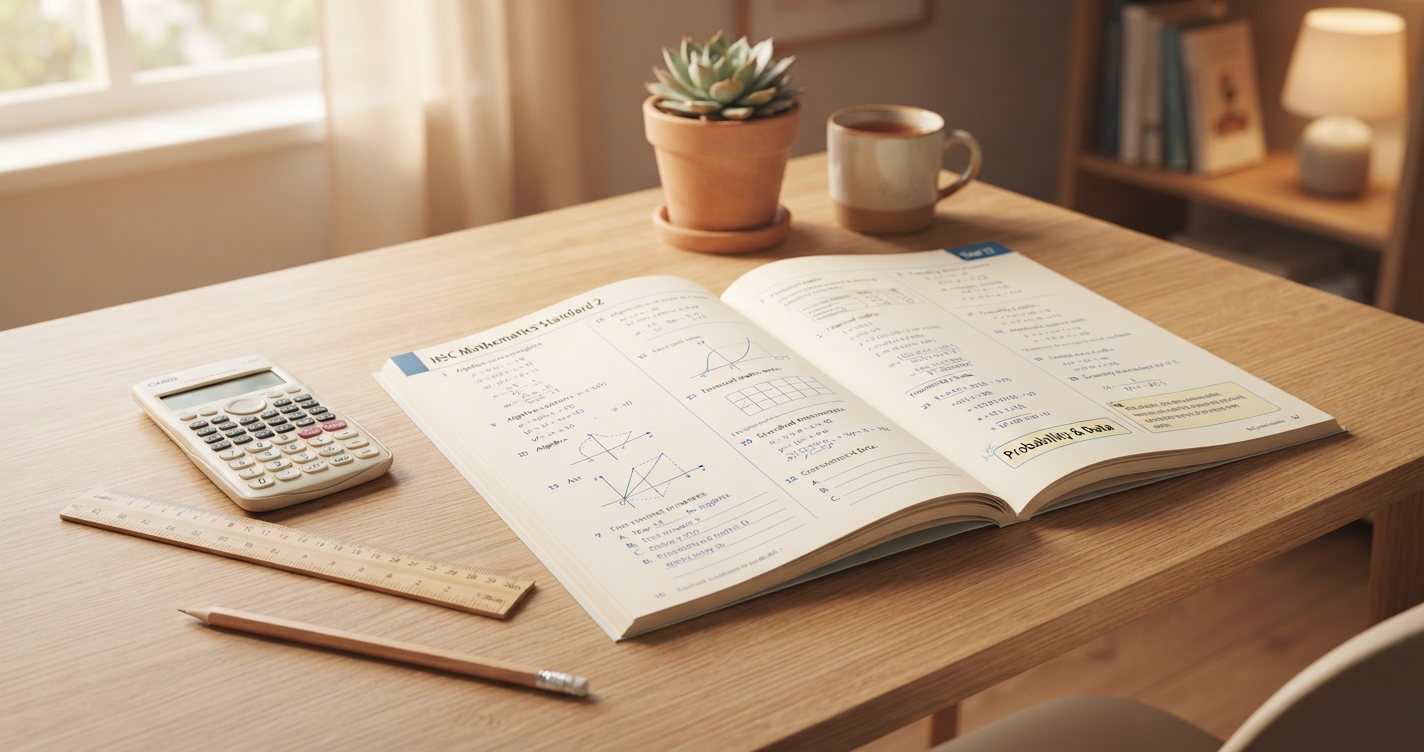
HSC Maths Standard 2: Complete Guide (2026)
Last updated: 20 July 2026
Standard 2 is the most common HSC Maths course in NSW. More students take it than Advanced, Extension 1, and Extension 2 combined. It's designed for students who don't need calculus for their university course but still want a solid maths foundation.
This guide covers what's in the course, how the exam works, and what it takes to score well.
What is HSC Maths Standard 2?
It's a 2-unit non-calculus HSC Maths course. It focuses on practical, real-world mathematics: financial maths, statistics, networks, and measurement. There's no calculus, no trigonometric identities, and no integration.
If you're heading toward business, nursing, education, design, or the trades, Standard 2 gives you the mathematical literacy you need without the heavy abstraction of Advanced.
Standard 2 vs Advanced
The biggest difference: Standard 2 has no calculus. Advanced does. That changes the entire character of the course.
Standard 2 is more about interpreting data, solving practical problems, and understanding financial concepts. Advanced is more about abstract mathematical techniques and problem-solving.
Standard 2 is not "easy maths." The financial mathematics content is genuinely challenging, and the statistics section requires careful thinking. But the mathematical techniques are less abstract than in Advanced.
Who should take Standard 2?
Consider it if:
- Your target uni course doesn't require calculus (check prerequisites carefully)
- You found Year 10 5.2 pathway manageable but 5.3 was a struggle
- You want to focus your time on other subjects
- You're more interested in practical maths than abstract maths
Don't take Standard 2 just because it sounds easier. If your uni course requires Advanced, taking Standard 2 will close doors. Check the prerequisites for every course you're considering before deciding.
Syllabus topics
Standard 2 has five topic areas.
1. Algebra
Solving linear equations, simultaneous equations, and quadratic equations. Working with formulas and rearranging them. This is foundational content that shows up throughout the course.
What you need to do: solve equations fluently, substitute values into formulas, rearrange formulas to make different variables the subject.
2. Measurement
Area and volume of standard shapes, including composite shapes. Converting between units. Working with rates and ratios. Similar figures and scale factor.
What you need to do: calculate areas and volumes of 2D and 3D shapes, convert between metric units, solve problems involving rates (speed, density, flow rate), use scale factor for similar figures.
3. Financial mathematics
This is the heart of Standard 2 and where most marks are. Purchasing goods (flat-rate interest, reducible interest), depreciation, managing money (earning, tax, overtime), and financial planning (investments, loans, annuities).
What you need to do: calculate interest on loans and investments, work with GST and tax brackets, compare different financial products, solve annuity and loan repayment problems.
4. Statistical analysis
Collecting and representing data. Measures of central tendency (mean, median, mode) and spread (range, standard deviation, interquartile range). Box plots, histograms, and scatter plots. Normal distribution and z-scores. Correlation.
What you need to do: calculate and interpret mean, median, mode, and standard deviation, construct and read box plots, work with the normal distribution, interpret scatter plots and correlation.
5. Networks
Network diagrams, vertices and edges, tree diagrams, minimum spanning tree (using Prim's algorithm), shortest path (using Dijkstra's algorithm), and project scheduling (critical path analysis).
This is a topic many students haven't seen before. It's visual and logical rather than computational. Once it clicks, it's relatively easy marks.
What you need to do: read and construct network diagrams, find minimum spanning trees, find shortest paths, identify critical paths in project networks.
The exam
The Standard 2 exam has two sections:
- Section I: 15 multiple-choice questions (15 marks, about 25 minutes)
- Section II: 11-13 short-answer questions (85 marks, about 2 hours 35 minutes)
Total: 100 marks, 3 hours, plus 5 minutes reading time.
Note: Standard 2 has 15 MC questions, compared to 10 in Advanced. Multiple choice is worth 15% of your exam. Don't neglect it.
Mark distribution
Financial mathematics and statistical analysis typically make up the largest portions. Networks is usually 12-15 marks. Measurement and algebra are spread throughout.
How to score a Band 6 in Standard 2
A Band 6 in Standard 2 requires precision. The content isn't as conceptually hard as Advanced, but the marking is detailed. You need to show working, use correct units, and round appropriately.
Master the financial maths
This is where Standard 2 lives or dies. If you can handle annuities, loans, and investment problems confidently, you're in good shape. Practice these until they're automatic.
The formula sheet provides annuity formulas, but you need to know when to use which one and how to interpret the result. A lot of students plug numbers in without understanding what they're calculating.
Show your working
Standard 2 marking is strict about working. Even if the answer is right, missing working can lose marks. Even if the answer is wrong, correct working can earn partial marks. Show every step.
Get the units right
Measurement and financial questions often specify units. If the question asks for the answer in square metres and you give it in square centimetres, you'll lose the mark. Check units at the end of every question.
Practise networks
A lot of students avoid networks because it's unfamiliar. That's a mistake. It's 12-15 marks of relatively straightforward content. Spend 2 hours on Prim's and Dijkstra's algorithms and you've secured those marks.
Know your calculator
Standard 2 involves a lot of computation. Know your calculator inside out: statistical mode, table mode, financial calculations. Being slow on the calculator costs time and leads to errors.
Common mistakes
Wrong formula for the financial situation. The formula sheet has several similar-looking formulas. Read the question carefully to determine whether it's asking for future value, present value, or a repayment amount.
Missing units. The most common reason students lose marks they should have earned. Write the unit after every answer.
Incorrect rounding. The question will specify rounding (e.g., "give your answer to the nearest cent"). Follow it exactly. Rounding too early in a multi-step calculation introduces errors.
Misreading network diagrams. The edges and vertices can be confusing. Label everything as you work through it.
Calculator errors. Entering values in the wrong order, forgetting to close brackets, using the wrong mode. Always sanity-check your answer. If a loan repayment is $50,000/month, you've made an error.
Resources
- NESA past papers and marking guidelines
- PracticePapers.io for interactive practice (free during beta)
- Cambridge Mathematics Standard 2 Year 12
- Excel HSC Maths Standard 2 Study Guide
- NESA reference sheet (practise with it!)
Want to practise?
PracticePapers.io covers Standard 2 with auto-marking, worked solutions, and weak-areas tracking. Free during beta.
Based on the current NESA HSC Mathematics Standard 2 syllabus. PracticePapers.io is not affiliated with NESA.