HSC Maths Proofs and Induction: The Complete Guide (Ext 1 & Ext 2)
Last updated: 24 July 2026
Proofs separate Extension from Advanced. Less computation, more logic. Good news: the structure is always the same. Learn the skeleton, fill in the details, collect the marks.
Mathematical induction
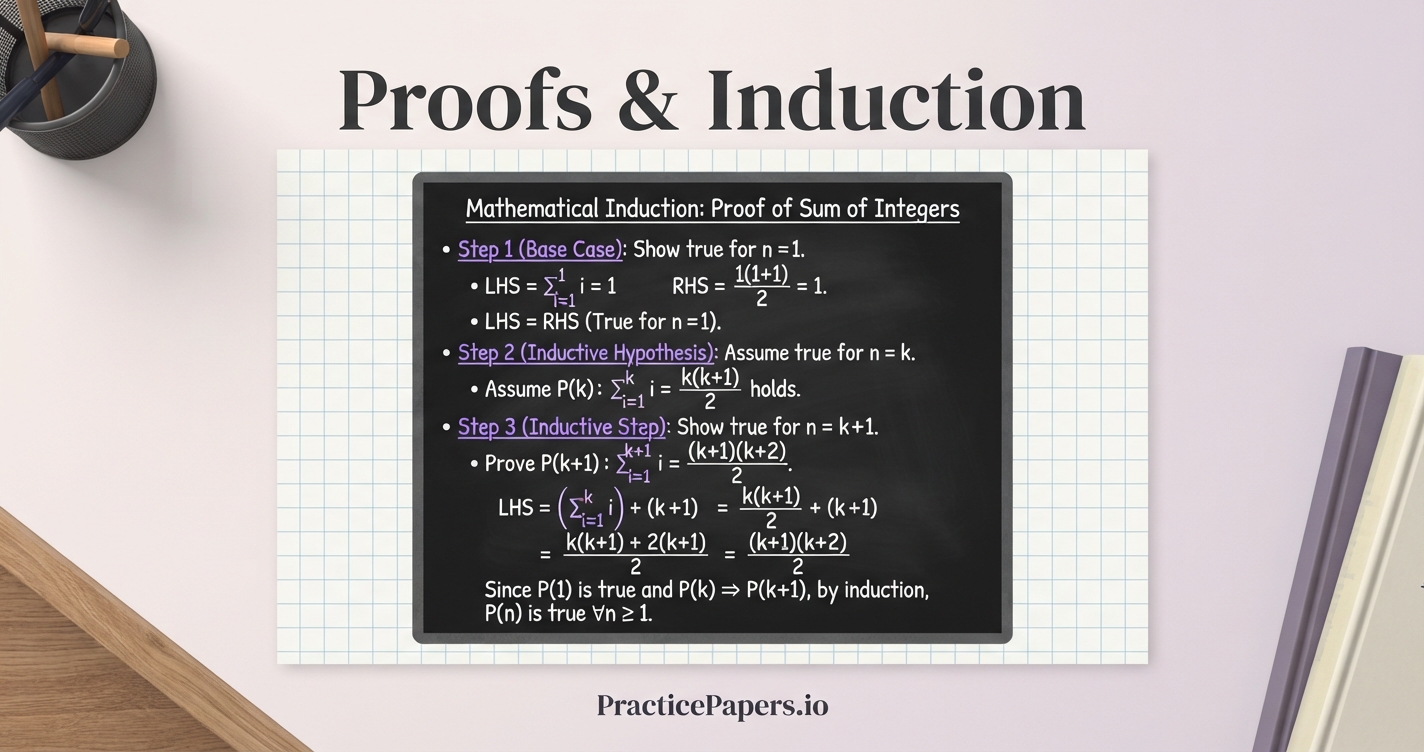
Induction is the most common proof method in the HSC. It has three steps:
- Prove it's true for n = 1 (the base case)
- Assume true for n = k (the induction hypothesis)
- Prove it's true for n = k + 1 (the inductive step)
Then conclude: by mathematical induction, it's true for all positive integers.
Induction example: sum of first n integers
Prove .
Step 1 (n = 1): LHS = 1, RHS = 1(2)/2 = 1. True.
Step 2 (assume n = k):
Step 3 (prove n = k+1):
That's the formula with n = k+1. Done.
Induction traps
- Don't assume the conclusion. You need to start from the LHS of the k+1 statement and manipulate it to the RHS using the induction hypothesis. Working backwards from the RHS loses marks.
- Divisibility proofs need a slightly different structure: factor out the thing you're proving divides.
- Recurrence relations give you the n = k+1 term in terms of previous terms. Use the hypothesis on the earlier terms.
Proof by contradiction
Assume the opposite of what you want to prove, then show it leads to a logical contradiction.
Classic HSC example: "Prove is irrational."
Assume in simplest form (p and q have no common factors). Square both sides: , so . This means p² is even, so p is even. Write p = 2r. Then , so , so . This means q² is even, so q is even. But if both p and q are even, they share a factor of 2 — contradicting our assumption that p/q was in simplest form.
Direct proof
Sometimes you just need to chain logical steps from what you know to what you need to show. These are common in geometry and vectors: "given this, prove that."
The key: write each step clearly. HSC markers award marks for correct logical flow even if your algebraic manipulation has minor errors, as long as the reasoning is sound.
What NESA actually asks
Induction shows up every year in Ext 1 and Ext 2. Typically:
- Ext 1: A series sum or divisibility proof (3-4 marks)
- Ext 2: Something trickier — recurrence, inequality, or De Moivre application (4-5 marks)
Proof by contradiction is less common but showed up in recent years for irrationality and geometry.
Practise the structure
Induction is 90% structure, 10% algebra. Do 5 induction proofs in a row and the pattern becomes automatic. The algebra changes but the skeleton doesn't.
Practise proof questions with step-by-step solutions on PracticePapers.io, free during beta.
Quick summary
- Induction: base case → assume k → prove k+1 → conclusion
- Contradiction: assume false → find contradiction → therefore true
- Direct: chain of logical steps
- Show all reasoning — method marks are generous in proof questions