HSC Maths Probability: The Only Guide You'll Actually Need
Probability shows up in both Mathematics Advanced and Standard 2, and it trips up more students than it should. The maths is rarely the hard part. The reading is.
This guide covers what you actually need: the notation, the diagrams, conditional probability, and the traps NESA keeps reusing.
The basics you can't skip
Probability measures how likely something is, from 0 (won't happen) to 1 (definitely will). Percentages run 0% to 100% if you prefer those.
- An event is something that might happen, like "the card is red."
- The sample space is every possible outcome.
- If all outcomes are equally likely, P(event) = (favourable outcomes) ÷ (total outcomes).
That last formula is the backbone. Most "hard" probability questions are just this wearing a costume.
Venn diagrams, your first weapon
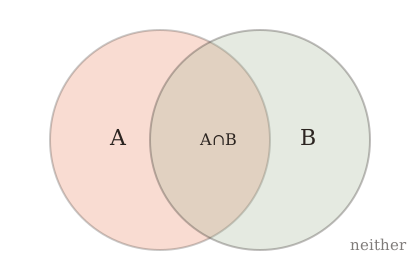
A Venn diagram shows overlapping sets: two circles in a box, the overlap being where both events happen.
Say P(A) = 0.4, P(B) = 0.5, and P(A and B) = 0.2.
- A only: 0.4 − 0.2 = 0.2
- B only: 0.5 − 0.2 = 0.3
- Neither: 1 − (0.2 + 0.2 + 0.3) = 0.3
The rule to remember: P(A or B) = P(A) + P(B) − P(A and B). You subtract the overlap so you don't count it twice.
Tree diagrams for sequences
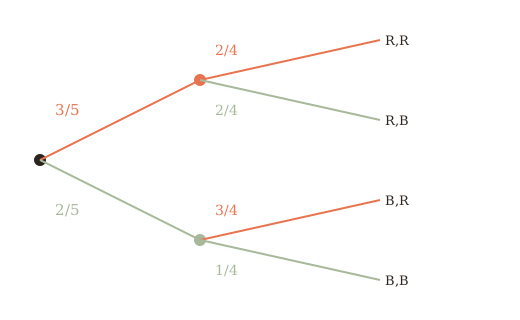
When events happen one after another, draw a tree. Each branch carries a probability. To get the probability of a path, you multiply down the branches.
Example: a bag has 3 red and 2 blue marbles. You draw two without replacement.
- First red: 3/5, then red again: 2/4, so the path is (3/5) × (2/4) = 6/20.
- Red then blue: (3/5) × (2/4) = 6/20 as well.
"Without replacement" changes the second denominator. That's the detail most students miss.
Conditional probability
This is the big one. P(A | B) means "the probability of A, given B already happened."
The formula:
Read it as: the slice where both happen, divided by all of B.
A common version: "Given a student passed, what's the chance they studied?" You're no longer looking at the whole cohort, you're restricted to the "passed" group. That restriction is the whole point of conditional probability.
The traps NESA loves
- "At least one" is almost always easier as 1 − P(none).
- Independent vs mutually exclusive. Independent events can both happen; mutually exclusive ones can't. Don't mix them up.
- Replacement. Always check whether the thing goes back in the bag.
- Word order. "A given B" is not the same as "B given A."
How to practise without wasting time
Don't grind random questions. Pull every probability question from the last five years of HSC papers and sort them by sub-topic. You'll see NESA recycling the same structures with new numbers.
On PracticePapers.io you can drill probability by topic and get a worked solution the moment you're stuck, no flipping to the back of a past paper. Try it free during beta.
Quick recap
- P(A or B) = P(A) + P(B) − P(A and B)
- Multiply down tree branches
- Conditional means restrict to the given event
- "At least one" means use the complement
Probability is a solid marks-per-hour bargain in the HSC. Learn the structures and these become the questions you look forward to.