HSC Maths Functions: Domain, Range, and the Transformations That Matter
Functions are the grammar of HSC maths. Almost every topic, calculus, trig, exponentials, statistics, is built on a function doing something. If domain and range feel shaky, the rest of the course feels harder than it is.
What a function actually is
A function takes an input and gives exactly one output. Graphically it passes the vertical line test: any vertical line crosses the graph at most once.
f(x) = x² is a function. A circle (x² + y² = 1) isn't, because most x-values give two y-values.
Domain and range
- Domain is every valid input (the x-values)
- Range is every possible output (the y-values)
For f(x) = √x, the domain is x ≥ 0 (no square rooting a negative in the real HSC). The range is y ≥ 0.
Watch for the usual suspects:
- Square roots: inside must be ≥ 0
- Fractions: denominator ≠ 0
- Logarithms: argument must be > 0
Transformations, order matters
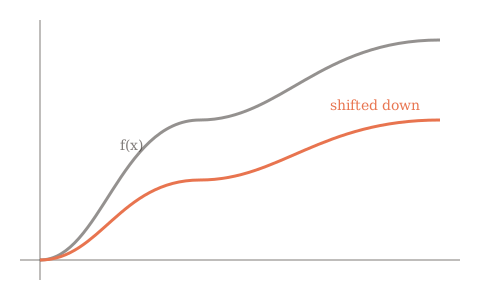
Starting from y = f(x):
- y = f(x) + a shifts up by a
- y = f(x − a) shifts right by a (minus shifts right, the opposite of what you'd guess)
- y = af(x) stretches vertically by a
- y = f(ax) compresses horizontally by a
- y = −f(x) reflects in the x-axis
- y = f(−x) reflects in the y-axis
Students drop marks by doing these in the wrong order. Safe approach: reflections and stretches first, then translations. Or rewrite f(2x − 4) as f(2(x − 2)) so the shift is obviously 2 to the right.
Composite and inverse functions
- Composite f(g(x)): do g first, then f.
- Inverse f⁻¹(x): reflect in the line y = x. Only exists if the function is one-to-one (passes the horizontal line test). Restrict the domain if you need to.
Classic question: given f(x) = 2x + 1, find f⁻¹(x). Swap x and y, x = 2y + 1, solve, y = (x − 1)/2.
Why this earns marks in the exam
Transformation questions show up in multiple-choice and short answer every year. Inverse functions appear in calculus (differentiating inverse trig) and exponentials (logarithms are inverses of exponentials).
Quick checklist
- Domain from restrictions: roots, fractions, logs
- Transformations: stretch and reflect before you shift
- Inverse means swap x and y, then solve for y