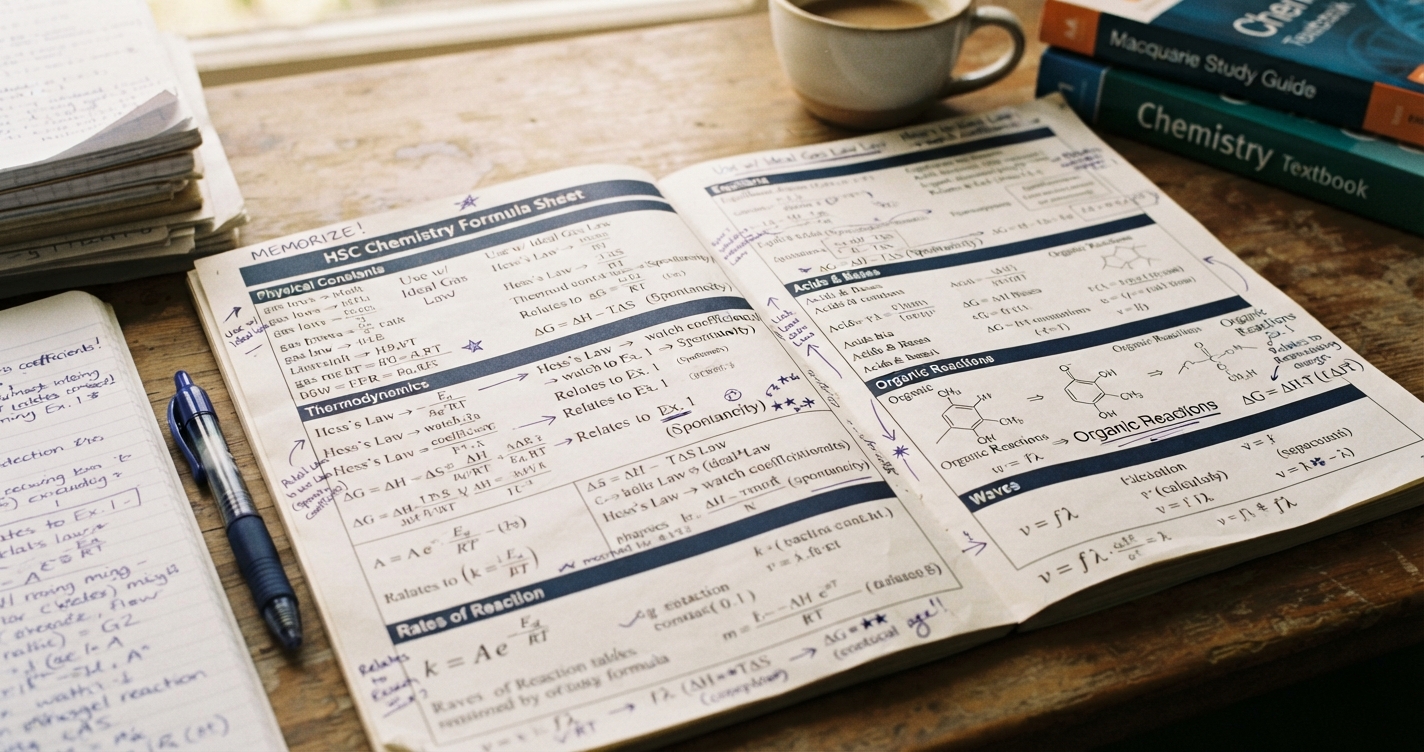
HSC Maths Formula Sheet Explained (2026)
Last updated: 20 July 2026
NESA gives you a reference sheet in every HSC Maths exam. Most students glance at it once and never look again. That's a mistake. Knowing what's on it, what isn't, and when to use each formula can save you time and marks in the exam.
This guide goes through every formula on the sheet, explains it in plain English, and tells you what you still need to memorise.
What is the reference sheet?
It's a single page of formulas you can use during the exam. Same sheet for Standard 2, Advanced, Extension 1, and Extension 2, though not every formula is relevant to every course.
The catch: it doesn't include everything. You need to know which formula to use for each question, how to apply it, and what's missing.
You can get the official version from the NESA website. Download it, print it, and use it during every practice session.
PracticePapers.io also has an interactive formula sheet with all 65 formulas across 14 topics, each with explanations, common mistakes, and worked examples.
What's on the sheet
Algebra
Quadratic formula:
Use it to solve any quadratic equation in the form ax² + bx + c = 0. The bit under the square root (b² - 4ac) is called the discriminant. If it's positive, two solutions. Zero, one solution. Negative, no real solutions.
Trigonometry
Sine rule:
Use it for non-right-angled triangles when you have a side and its opposite angle.
Cosine rule:
Use it when you have two sides and the angle between them, or when you have all three sides and need an angle.
Area of a triangle:
Use it when you know two sides and the included angle but don't have a base and height.
Arc length:
Use it to find the length of an arc. In Advanced and above, you'll be working in radians.
Series and sequences
Arithmetic sequence:
Use it when terms go up or down by a constant amount. Shows up in simple interest and loan repayment questions.
Geometric sequence:
Use it when each term is multiplied by a constant ratio. Shows up in compound interest and annuity questions.
Infinite geometric series:
Use it when a geometric series converges (ratio between -1 and 1). Appears in Extension 1.
Calculus: differentiation
Power rule:
Product rule:
Quotient rule:
Chain rule:
These are the four rules you'll use constantly. The product rule is for multiplying functions, quotient for dividing, chain for composite functions. Most real questions need a combination of them.
Calculus: integration
These are the basics. Harder integrals need techniques like substitution, which is covered in Extension 1. Note the negative sign on the sine integral. That catches a lot of students.
Statistics
Z-score:
Converts any normal distribution to the standard normal so you can look up probabilities. The empirical rule: 68% of data falls within 1 standard deviation, 95% within 2, 99.7% within 3.
Expected value:
The mean of a discrete probability distribution.
Variance:
Measures how spread out a distribution is.
Financial mathematics
Compound interest:
Future value of an investment with compound interest.
Annuity (future value):
Future value of regular deposits.
Annuity (present value):
Present value or loan amount based on regular repayments.
What's NOT on the sheet
This is where students get caught. They assume a formula will be there and it isn't. Here's what you need to memorise.
Trig values you must know cold
- sin(0) = 0, cos(0) = 1
Derivatives you must know cold
- d/dx(ln x) = 1/x
- d/dx(sin x) = cos x
- d/dx(cos x) = -sin x
Logarithm laws (not on the sheet)
- Change of base: logₐ(x) = log(x)/log(a)
Tips for using the sheet in the exam
- Know where everything is. Practise with the sheet so you can find formulas fast. Three hours goes quickly.
- Don't rely on it for everything. Basic differentiation rules should be automatic. The sheet is for less frequent formulas.
- If you can't remember a formula, check the sheet rather than guessing. A wrong formula costs you the whole question.
- Check the notation. The sheet uses specific notation and you need to understand what each symbol means before exam day.
- After solving a problem, verify your formula matches the sheet. Catches memory errors.
Common mistakes
- Using the wrong formula. The sheet has similar-looking formulas (arithmetic vs geometric series, for example). Read carefully.
- Substituting incorrectly. The sheet shows formulas in general form. Make sure you correctly identify which values are a, b, c, n, r in the question.
- Forgetting + C in integration. The sheet includes it. Students forget it when working fast.
- Confusing degrees and radians. Some formulas work with both, but trig in calculus requires radians.
- Assuming a formula is on the sheet when it isn't. Memorise the ones listed above.
The interactive version
The PracticePapers.io formula sheet has 65 formula cards across 14 topics, covering all four HSC courses. Each formula comes with a plain-English explanation, common mistake warnings, and worked examples. There's live search, course filtering, and a print mode.
Based on the current NESA HSC Mathematics reference sheet. Always check the official NESA website for the latest version. PracticePapers.io is not affiliated with NESA.