HSC Financial Maths: Annuities, Loans, and Why the Formula Matters
Financial maths is where the HSC gets practical. Compound interest, savings plans, home loans, this is maths you'll actually use after school. It's also formula-heavy, which works in your favour: learn the formulas and the questions turn mechanical.
Compound interest
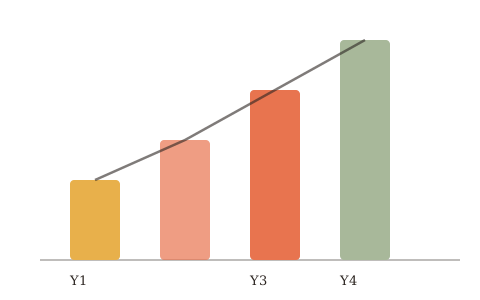
Money invested grows by a percentage each period. The formula:
A is the final amount, P the principal, r the interest rate per period, n the number of periods.
Example: $1,000 at 5% a year, compounded annually for 3 years.
Compounded monthly, r becomes the monthly rate (0.05/12) and n becomes months (36). Watch the compounding frequency, NESA loves testing it.
Sequences and series first
Before annuities you need arithmetic and geometric sequences.
- Arithmetic: each term adds a constant (d). Tₙ = a + (n−1)d
- Geometric: each term multiplies by a constant (r). Tₙ = ar^(n−1)
A savings account earning compound interest is a geometric sequence. That connection is the foundation for everything below.
Annuities, regular deposits
An annuity is a series of equal payments at regular intervals, earning interest. The future value uses:
M is the regular payment, r the rate per period, n the number of payments.
This is the "I deposit $200 a month for 5 years" question. Plug in, don't panic.
Loan repayments
A loan runs the other way: borrow a lump sum, pay it back in instalments. The present value of an annuity applies:
Set PV to the loan amount, solve for M (the repayment). Your calculator's TVM solver does this in seconds, learn it.
The trap: present vs future value
Students mix these up constantly. Ask yourself: am I working out what I'll have (future) or what a stream of payments is worth now (present)? Future value is savings. Present value is loans and investments you're valuing today.
Make it stick
Financial maths is pure repetition. The formulas are on the reference sheet, so the real skill is recognising which one the question wants. Do ten annuity questions in a row and you'll stop freezing in the exam.
Bottom line
Compound interest, annuities, loans. Three formulas, endless variations. Learn to spot which scenario you're in and the marks follow.