HSC Maths Complex Numbers: The Ext 2 Survival Guide
Last updated: 24 July 2026
Complex numbers are the first thing you learn in Extension 2 and they never leave. They turn up in polynomials, vectors, calculus, proofs. If you nail them early, the rest of Ext 2 slots into place.
The big idea
A complex number has a real part and an imaginary part: , where .
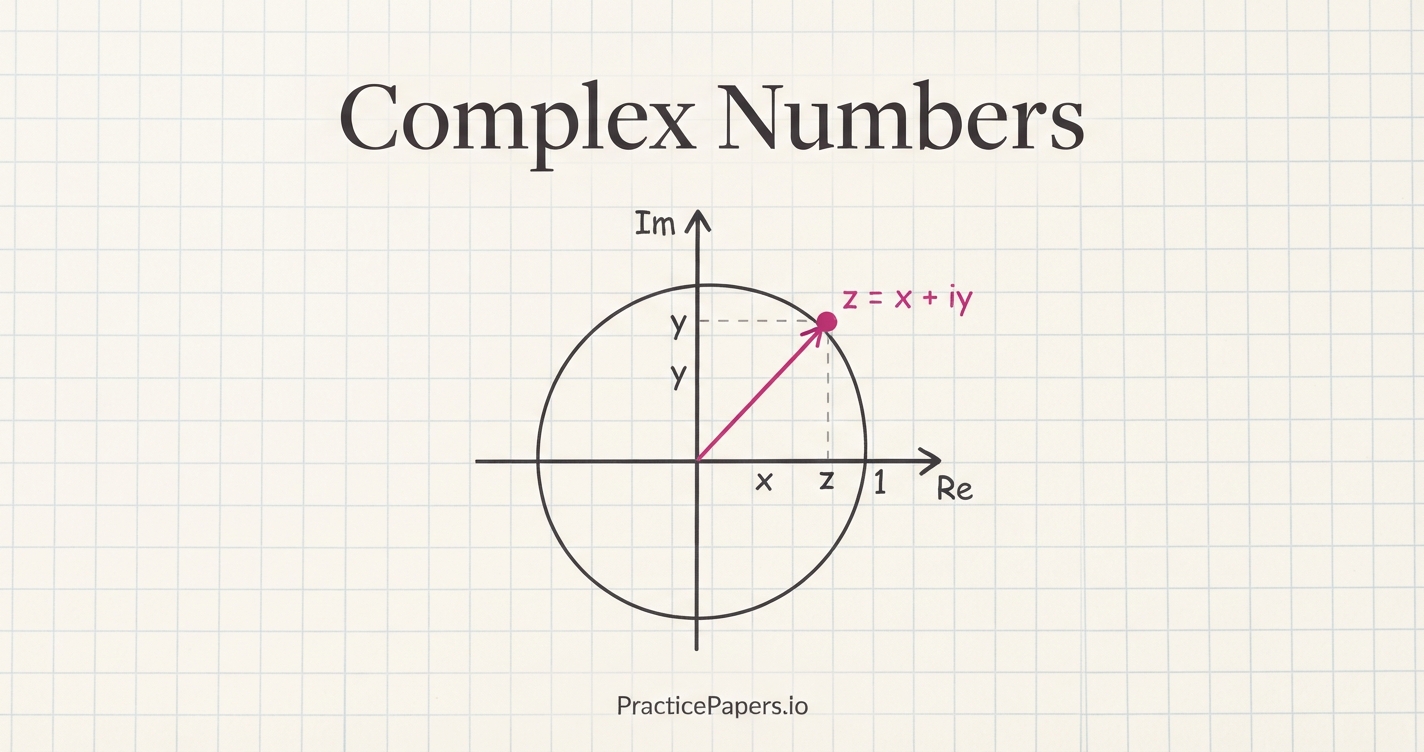
That is the whole trick. Every complex number is a point on the Argand diagram — x-axis is real, y-axis is imaginary.
Modulus and argument
The modulus () is the distance from the origin — Pythagoras again. The argument () is the angle from the positive real axis.
These two things let you switch between Cartesian () and modulus-argument (polar) form. The polar form is:
where and .
Why polar form matters
Multiplying and dividing complex numbers is tedious in Cartesian. In polar form it's clean:
- Multiply: multiply the moduli, add the arguments
- Divide: divide the moduli, subtract the arguments
- Powers: raise the modulus to the power, multiply the argument
That last one is De Moivre's theorem:
De Moivre's theorem — the workhorse
This theorem is how you find powers of complex numbers, roots of complex numbers, and trig identities.
Finding roots: To find the th roots of a complex number, raise the modulus to and divide the argument by . Add for each successive root. The roots are equally spaced around the Argand circle.
Trig identities: Expand using the binomial theorem, equate real and imaginary parts, and you get and expressed in powers of and .
Conjugates
The conjugate of is . Visually, it's a reflection across the real axis.
Key facts:
- The conjugate of a product is the product of the conjugates
- Real coefficients mean roots come in conjugate pairs
Polynomials with complex roots
If a polynomial has real coefficients and one complex root , then is also a root. This is why cubics always have at least one real root — the complex ones come in pairs.
You'll use this to factor polynomials that look unfactorable and to find all roots of a quartic when you're given one complex root.
The loci questions
"Sketch the region where " — this is describing a circle centred at with radius 2. Loci questions test whether you see geometry in the algebra.
Common ones:
- — circle centre , radius
- — perpendicular bisector of the segment joining and
- — ray from at angle
How to get good
Complex numbers snowball. If you're shaky on polar form, De Moivre's will be miserable. Practise the conversions first, then the theorems, then the loci.
Memory aid
- Cartesian → point on a plane
- Polar → angle and distance from origin
- De Moivre → powers are easy in polar
- Conjugate pairs → real coefficients always means paired roots