HSC Maths HSC Maths Cheat Sheet: Every Formula You Actually Need (Printable) PP PracticePapers.io2026-07-24 5 min read
HSC Maths Cheat Sheet: Every Formula You Actually Need (Printable)
Last updated: 24 July 2026
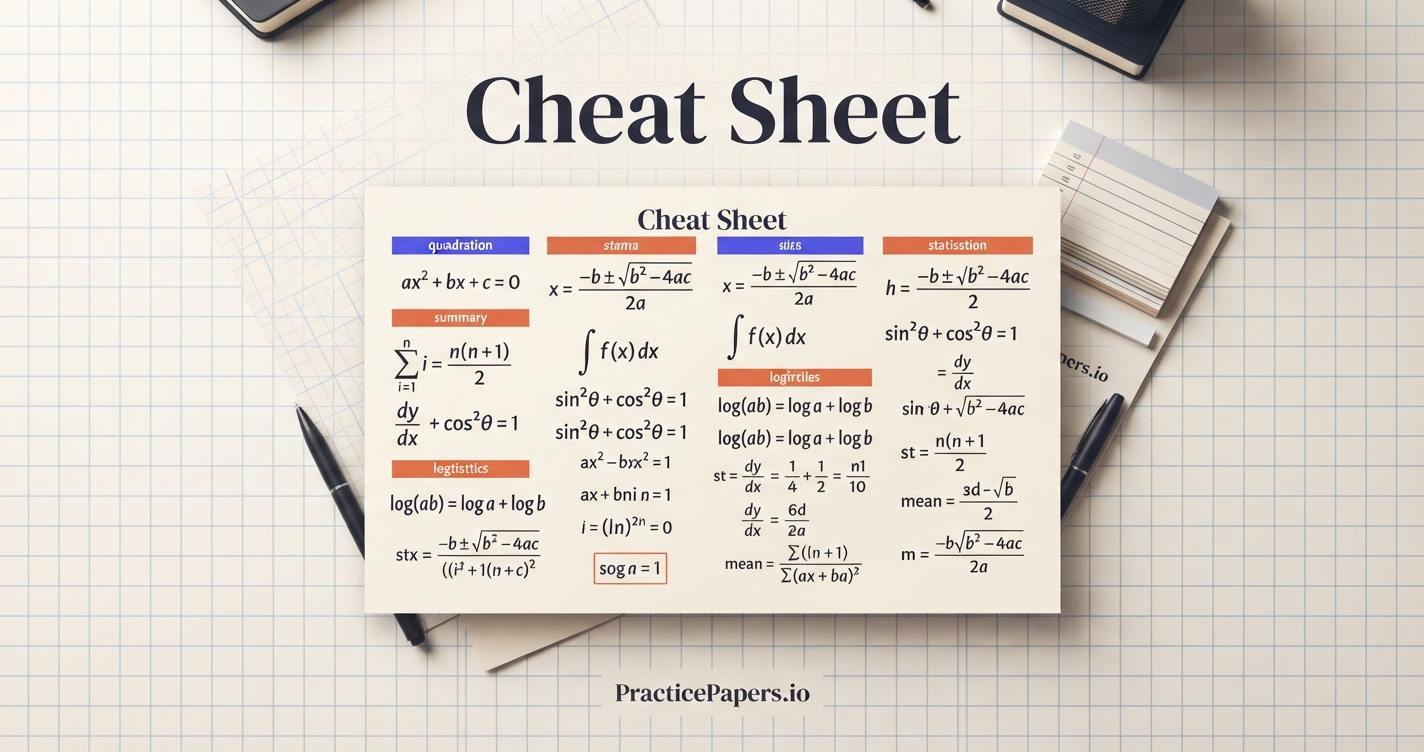
The HSC gives you a formula sheet in the exam. But it's crowded and not organised by what actually comes up. This cheat sheet cuts through that noise — just the formulas you'll reach for, grouped by topic, with quick examples.
Print this. Stick it on your wall. Take a photo for your phone. Use it during topic drills until you don't need it anymore.
Algebra
Formula
Example
Quadratic formula: x = − b ± b 2 − 4 a c 2 a x = \frac{-b \pm \sqrt{b^2 - 4ac}}{2a} x = 2 a − b ± b 2 − 4 a c
x 2 − 5 x + 6 = 0 x^2 - 5x + 6 = 0 x 2 − 5 x + 6 = 0 x = 2 , 3 x = 2, 3 x = 2 , 3
Discriminant: Δ = b 2 − 4 a c \Delta = b^2 - 4ac Δ = b 2 − 4 a c
Δ > 0 \Delta > 0 Δ > 0 Δ = 0 \Delta = 0 Δ = 0 Δ < 0 \Delta < 0 Δ < 0
Log rules: log a b = log a + log b \log ab = \log a + \log b log ab = log a + log b log ( a / b ) = log a − log b \log(a/b) = \log a - \log b log ( a / b ) = log a − log b log a n = n log a \log a^n = n\log a log a n = n log a
log 100 = 2 \log 100 = 2 log 100 = 2
Exponential: A = P e r t A = Pe^{rt} A = P e r t
Continuous growth/decay
Calculus
Formula
Example
d d x x n = n x n − 1 \frac{d}{dx}x^n = nx^{n-1} d x d x n = n x n − 1 d d x x 3 = 3 x 2 \frac{d}{dx}x^3 = 3x^2 d x d x 3 = 3 x 2
d d x e x = e x \frac{d}{dx}e^x = e^x d x d e x = e x Derivative of e x e^x e x
d d x sin x = cos x \frac{d}{dx}\sin x = \cos x d x d sin x = cos x d d x cos x = − sin x \frac{d}{dx}\cos x = -\sin x d x d cos x = − sin x
Product rule: ( u v ) ′ = u ′ v + u v ′ (uv)' = u'v + uv' ( uv ) ′ = u ′ v + u v ′
d d x x 2 sin x = 2 x sin x + x 2 cos x \frac{d}{dx}x^2\sin x = 2x\sin x + x^2\cos x d x d x 2 sin x = 2 x sin x + x 2 cos x
Chain rule: d y d x = d y d u ⋅ d u d x \frac{dy}{dx} = \frac{dy}{du} \cdot \frac{du}{dx} d x d y = d u d y ⋅ d x d u
d d x sin ( 2 x ) = 2 cos ( 2 x ) \frac{d}{dx}\sin(2x) = 2\cos(2x) d x d sin ( 2 x ) = 2 cos ( 2 x )
∫ x n d x = x n + 1 n + 1 + C \int x^n dx = \frac{x^{n+1}}{n+1} + C ∫ x n d x = n + 1 x n + 1 + C ∫ x 2 d x = x 3 3 + C \int x^2 dx = \frac{x^3}{3} + C ∫ x 2 d x = 3 x 3 + C
∫ e x d x = e x + C \int e^x dx = e^x + C ∫ e x d x = e x + C —
Area under curve: ∫ a b f ( x ) d x \int_a^b f(x) dx ∫ a b f ( x ) d x
Between curve and x-axis
Trapezoidal rule: ∫ a b f ( x ) d x ≈ h 2 [ f ( a ) + 2 ∑ f ( x i ) + f ( b ) ] \int_a^b f(x)dx \approx \frac{h}{2}[f(a) + 2\sum f(x_i) + f(b)] ∫ a b f ( x ) d x ≈ 2 h [ f ( a ) + 2 ∑ f ( x i ) + f ( b )]
Where h = ( b − a ) / n h = (b-a)/n h = ( b − a ) / n
Trigonometry
Formula
Example
sin 2 θ + cos 2 θ = 1 \sin^2\theta + \cos^2\theta = 1 sin 2 θ + cos 2 θ = 1 Identity. Rearranges to sin 2 = 1 − cos 2 \sin^2 = 1 - \cos^2 sin 2 = 1 − cos 2
tan θ = sin θ cos θ \tan\theta = \frac{\sin\theta}{\cos\theta} tan θ = c o s θ s i n θ —
Sine rule: a sin A = b sin B = c sin C \frac{a}{\sin A} = \frac{b}{\sin B} = \frac{c}{\sin C} s i n A a = s i n B b = s i n C c
For non-right triangles
Cosine rule: c 2 = a 2 + b 2 − 2 a b cos C c^2 = a^2 + b^2 - 2ab\cos C c 2 = a 2 + b 2 − 2 ab cos C
Rearranges to find angles
Area: A = 1 2 a b sin C A = \frac{1}{2}ab\sin C A = 2 1 ab sin C
For non-right triangles
Extension formulas:
sin ( A + B ) = sin A cos B + cos A sin B \sin(A + B) = \sin A\cos B + \cos A\sin B sin ( A + B ) = sin A cos B + cos A sin B cos ( A + B ) = cos A cos B − sin A sin B \cos(A + B) = \cos A\cos B - \sin A\sin B cos ( A + B ) = cos A cos B − sin A sin B sin 2 A = 2 sin A cos A \sin 2A = 2\sin A\cos A sin 2 A = 2 sin A cos A cos 2 A = cos 2 A − sin 2 A = 2 cos 2 A − 1 = 1 − 2 sin 2 A \cos 2A = \cos^2 A - \sin^2 A = 2\cos^2 A - 1 = 1 - 2\sin^2 A cos 2 A = cos 2 A − sin 2 A = 2 cos 2 A − 1 = 1 − 2 sin 2 A
Probability and Statistics
Formula
Notes
P ( A ∪ B ) = P ( A ) + P ( B ) − P ( A ∩ B ) P(A \cup B) = P(A) + P(B) - P(A \cap B) P ( A ∪ B ) = P ( A ) + P ( B ) − P ( A ∩ B ) Union: don't double-count overlap
P ( A ∣ B ) = P ( A ∩ B ) P ( B ) P(A \mid B) = \frac{P(A \cap B)}{P(B)} P ( A ∣ B ) = P ( B ) P ( A ∩ B ) Conditional: restrict to B
68-95-99.7 rule
Within 1/2/3 SD of mean
z = x − μ σ z = \frac{x - \mu}{\sigma} z = σ x − μ Standardised score
Finance
Formula
Notes
A = P ( 1 + r ) n A = P(1 + r)^n A = P ( 1 + r ) n Compound interest
F V = M ( 1 + r ) n − 1 r FV = M\frac{(1 + r)^n - 1}{r} F V = M r ( 1 + r ) n − 1 Future value of annuity
P V = M 1 − ( 1 + r ) − n r PV = M\frac{1 - (1 + r)^{-n}}{r} P V = M r 1 − ( 1 + r ) − n Present value / loan
r r r n n n Match the compounding frequency
Extension 1: Vectors
Formula
Notes
a ⋅ b = ∥ a ∥ ∥ b ∥ cos θ \mathbf{a} \cdot \mathbf{b} = \lVert \mathbf{a} \rVert \lVert \mathbf{b} \rVert \cos\theta a ⋅ b = ∥ a ∥ ∥ b ∥ cos θ Dot product = angle finder
Perpendicular: a ⋅ b = 0 \mathbf{a} \cdot \mathbf{b} = 0 a ⋅ b = 0
Zero dot = right angle
proj b a = a ⋅ b b ⋅ b b \text{proj}_{\mathbf{b}}\mathbf{a} = \frac{\mathbf{a} \cdot \mathbf{b}}{\mathbf{b} \cdot \mathbf{b}}\mathbf{b} proj b a = b ⋅ b a ⋅ b b Vector projection
Extension 2: Complex Numbers
Formula
Notes
z = x + i y = r ( cos θ + i sin θ ) z = x + iy = r(\cos\theta + i\sin\theta) z = x + i y = r ( cos θ + i sin θ ) Cartesian ↔ polar
De Moivre: ( cos θ + i sin θ ) n = cos ( n θ ) + i sin ( n θ ) (\cos\theta + i\sin\theta)^n = \cos(n\theta) + i\sin(n\theta) ( cos θ + i sin θ ) n = cos ( n θ ) + i sin ( n θ )
Powers made easy
Conjugate: z × z ‾ = ∣ z ∣ 2 z \times \overline{z} = \lvert z \rvert^2 z × z = ∣ z ∣ 2
Product with conjugate = real
Quick exam tips
Show working. Method marks are real marks. Even if you can do it in your head, write the steps.Draw a diagram. For geometry, vectors, trig — sketch first.Check the domain. Multiple solutions in trig? Domain determines which count.Use your formula sheet. During topic drills, have it open. Train your eye for where things are.If stuck for 5 minutes, move. The easy marks are elsewhere in the paper.
Print this, work through it during topic drills, and by exam day it'll be muscle memory.
Practise every formula with instant feedback on PracticePapers.io, free during beta.
Ready to put this into practice? Get HSC-style practice questions with instant auto-marking, worked solutions, and weak-areas tracking. Free during beta. Join the waitlist:
Or join on our site →