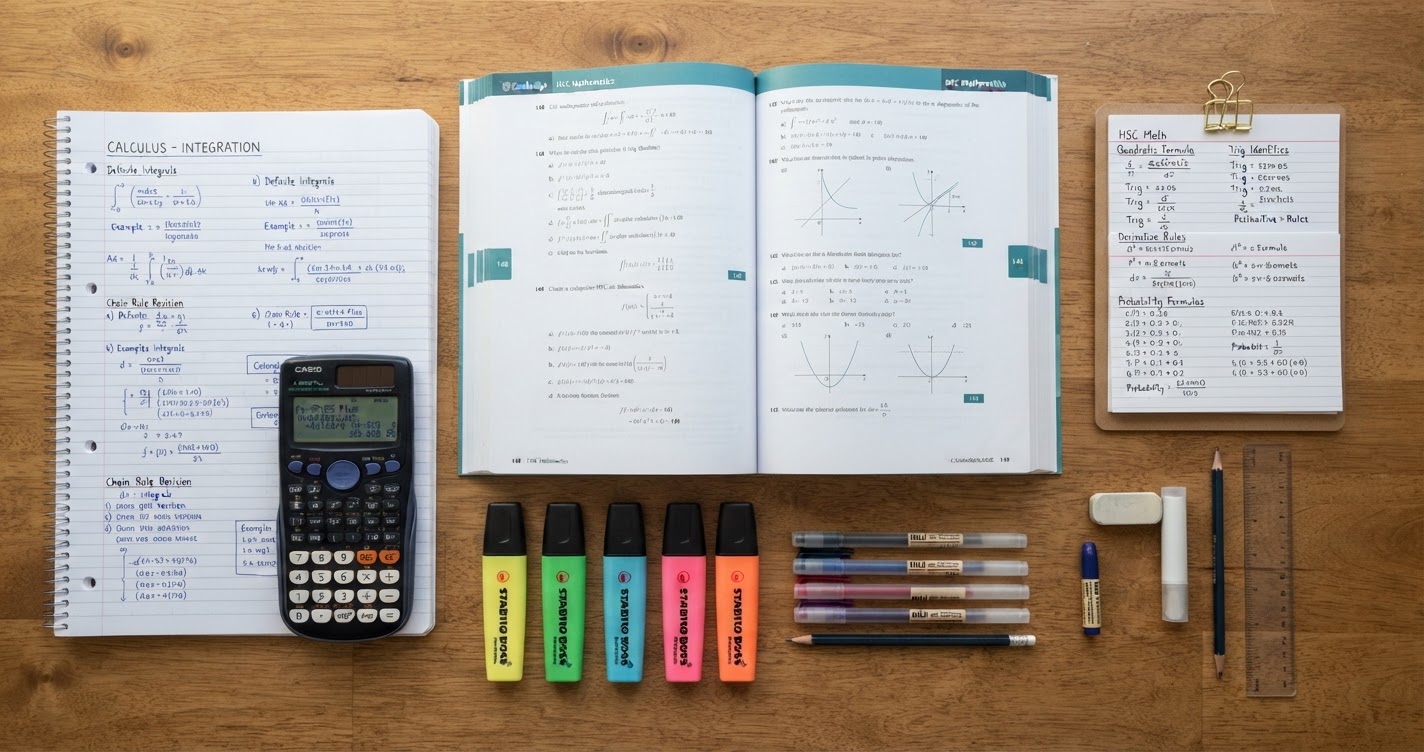
How to Study for HSC Maths (Without Losing Your Mind)
Last updated: 20 July 2026
Every maths teacher says the same thing: "just do past papers." It's not bad advice, but it's incomplete, and for a lot of students it doesn't work. You do 20 past papers and your marks barely move. Why?
Because doing past papers without a system is like driving with your eyes closed and hoping you'll learn the road. You hit the same walls every time.
This guide covers what actually works. The strategies come from learning science research, not from vague advice. They apply whether you're doing Standard 2, Advanced, Extension 1, or Extension 2.
Why "just do past papers" fails
Three things go wrong when you grind through papers without a plan:
- You keep making the same mistakes because nobody tells you what they are
- You waste time on topics you can already do in your sleep
- You don't get feedback until you mark the paper, by which point you've forgotten what you were thinking when you wrote the answer
The research points to a better approach. John Hattie's Visible Learning and Anders Ericsson's work on deliberate practice both show that improvement comes from targeted work on weaknesses, not volume of practice.
The method
1. Figure out where you're losing marks
Before you touch another past paper, do one mixed-topic practice set and track every single mistake. Not just "got it wrong" but why. Was it a concept gap (you didn't know the method), a calculation error (you knew what to do but stuffed it up), or a misread (you answered a different question to the one asked)?
The HSC Maths Advanced syllabus has six topic areas: Functions, Trigonometric Functions, Calculus (Differentiation), Calculus (Integration), Financial Mathematics, and Statistical Analysis. Extension 1 adds Combinatorics, Vectors, Further Calculus, and Proof. Extension 2 adds Complex Numbers, Further Mechanics, and Advanced Proof.
You need to know which of these are costing you marks.
2. Go hard on your weak topics
Once you know your weak spots, spend roughly 70% of your study time there and 30% keeping your strong areas sharp. This is what "deliberate practice" actually means: targeting the things you're bad at instead of rehearsing what you already know.
Say you're losing marks on integration. Work through it in layers:
- Re-learn the concept. Read your notes, watch a video, ask your teacher
- Do basic procedural questions until they're automatic
- Move to application questions (area under curve, rates of change)
- Finally, do HSC-level exam questions with marking guidelines
Don't skip ahead. If you can't get 80% on the procedural stuff, the exam questions will just demoralise you.
3. Stop reading, start doing
Reading your notes is not studying. Watching a Khan Academy video is not studying. Both feel productive because the material is familiar, but research calls this the "illusion of competence." You recognise the content but you can't reproduce it under pressure.
Active recall is the fix. Close your book and solve problems from memory. After reviewing a topic, immediately do 5-10 questions without your notes. If you bomb them, go back, relearn, and try again. It feels worse than reading (because you're confronting what you don't know), but it works.
4. Space it out
Don't do all of integration on Monday and never touch it again. Spacing your practice over days and weeks produces dramatically better retention than cramming. This is one of the most robust findings in cognitive psychology.
A simple schedule:
- Day 1: Learn the topic, do practice questions
- Day 3: Do 3-5 mixed questions on it
- Day 7: Include 2-3 questions in a mixed set
- Day 14: Put it in a mini-exam
- Day 30: Include it in a full practice paper
5. Worked solutions, not just answers
When you get a question wrong, the marking guidelines tell you the right answer. They usually don't explain how to get there. That gap is where most learning actually happens.
A good worked solution shows what the question is asking, which method to use, each step of the working, where students typically go wrong, and how to verify the answer.
Every time you get a question wrong, write out the full worked solution by hand. Not just read it. Write it. This forces you to process every step instead of skimming and thinking "yeah, I get it."
6. Exam conditions, but not yet
Start doing timed papers 6-8 weeks before the HSC exam. Before that, you're building understanding, not speed.
When you do timed papers: use the actual time limits, no notes (unless the exam allows a formula sheet), mark with the real marking guidelines, and track your marks by topic across papers so you can see patterns.
A sample week
| Day | What to do | Time |
|---|---|---|
| Monday | Weak topic: targeted practice (e.g., integration) | 1.5 hrs |
| Tuesday | Different topics: mixed practice questions | 1.5 hrs |
| Wednesday | Review mistakes from Mon/Tue, write worked solutions | 1 hr |
| Thursday | Weak topic: exam-style questions | 1.5 hrs |
| Friday | Mixed set covering earlier topics (spaced repetition) | 1 hr |
| Saturday | Timed practice paper (if 6-8 weeks out from exam) | 3 hrs |
| Sunday | Mark paper, analyse mistakes, plan next week | 1.5 hrs |
That's about 10-11 hours a week. Enough to make real progress if the time goes into deliberate practice, not passive review.
Mistakes that will cost you marks
Ignoring the formula sheet. NESA gives you a reference sheet in the exam. Most students never practise with it. Download it, print it, use it every time you study. You should know where every formula is so you're not flipping through it during the exam.
Skipping working. HSC marking gives partial marks for correct working even if the answer is wrong. If you skip steps in practice, you'll skip them in the exam. Show full working every time. It's a habit, and habits are built through repetition.
Only doing recent papers. The syllabus changed in 2020, so anything from 2020 onwards is fair game. But also try trial papers from selective schools. They often test concepts in ways the HSC hasn't yet, and those are the questions that separate Band 5 from Band 6.
Not tracking mistakes. If you get a question wrong, look at the answer, and move on, you will make the same mistake again. Keep a mistakes journal. A simple list: the question, the topic, what went wrong (concept, calculation, misread), and the corrected solution. Review it weekly.
Cramming. Maths is a skill. You can't cram skills the way you cram facts. In the final week before the exam, do light practice (1-2 questions per topic), review your mistakes journal, and sleep. Cramming at 2am the night before will lower your score, not raise it.
How PracticePapers.io fits in
The platform was built around these principles. It tracks which topics you're losing marks on so you don't have to guess. Every question comes with a worked solution, not just an answer. You can drill specific topics instead of doing full papers every time. Auto-marking means instant feedback, and the Isaac AI tutor can explain concepts in English, Arabic, Chinese, Vietnamese, or Hindi when you're stuck.
It's free during beta. Try it here.
PracticePapers.io provides HSC-style practice questions based on the NESA syllabus. We are not affiliated with NESA. Always cross-reference with your teacher and the official NESA syllabus.