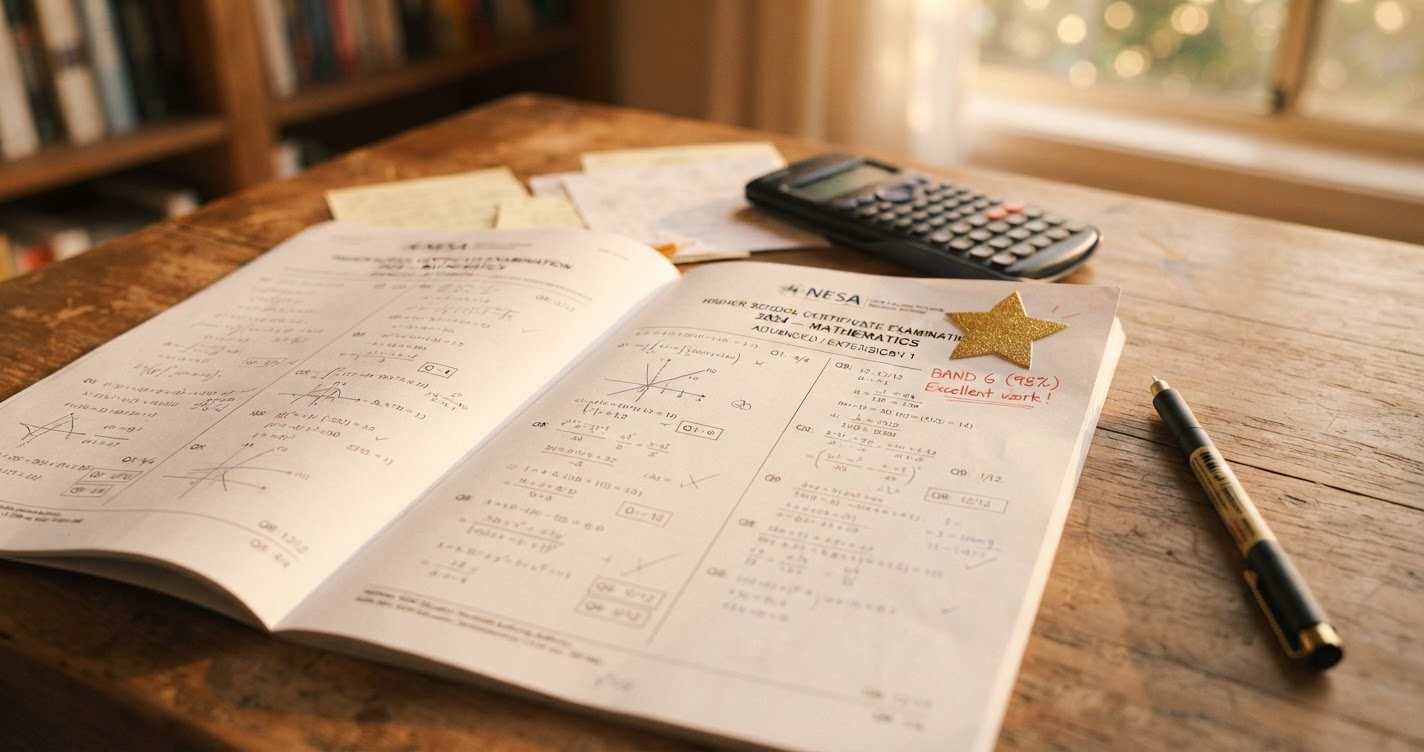
How to Get a Band 6 in HSC Maths
Last updated: 20 July 2026
A Band 6 in HSC Maths means you scored 90 or above out of 100. That's the top performance band. In Advanced Maths, roughly 8-12% of students achieve it each year. In Standard 2, it's around 5-8%.
The gap between Band 5 (80-89) and Band 6 (90+) isn't about knowing more content. By exam time, most Band 5 students know the syllabus. The difference is in precision, exam technique, and eliminating the small errors that add up.
Here's what it actually takes.
1. Zero careless errors
This is the single biggest difference between Band 5 and Band 6. A Band 5 student loses 8-12 marks to careless errors. A Band 6 student loses 2-4.
Careless errors include:
- Arithmetic mistakes (3 × 4 = 7 instead of 12)
- Sign errors (forgetting a negative)
- Copying the wrong number from the question
- Forgetting + C in integration
- Wrong units in measurement
- Not rounding as specified
You can't eliminate these entirely, but you can reduce them dramatically. The method:
Show every line of working. When you write out each step, errors become visible. When you do steps in your head, they don't.
Check each line as you write it. Before moving to the next line, look at the previous one. Does it follow from the line before? Are the numbers right?
Use your calculator for every calculation, even easy ones. Mental arithmetic is where errors creep in. 7 × 8 is 56, not 54. Your calculator knows this. Your brain under exam pressure does not.
2. Master the hard topics
You cannot get 90+ if you're weak on any major topic. A Band 6 student can answer questions on every syllabus topic with confidence. There's no skipping a section and hoping it doesn't come up.
For Advanced, calculus is 35-45% of the exam. If your calculus is shaky, 90 is not realistic. Focus there first.
For Extension 1 and 2, the new topics (combinatorics, vectors, complex numbers, proof) are where students lose marks because they spend all their time on calculus. Balance your practice across all topics.
3. Handle unfamiliar questions
HSC exams always include questions that don't look like textbook exercises. They combine topics, use unusual contexts, or ask you to prove something you haven't seen before.
Band 6 students handle these because they understand the underlying concepts, not just the procedures. If you've only memorised "when I see this type of question, I do these steps," you'll freeze on unfamiliar questions.
To develop this:
- Do trial papers from selective schools (they write harder, less predictable questions)
- When you get a question wrong, don't just learn the correct method. Ask yourself why that method works and how you'd know to use it
- Try to solve questions multiple ways. If you can integrate by substitution AND by parts, you have options when one approach fails
4. Perfect exam technique
Time management
A Band 6 student finishes the exam with time to spare for checking. If you're rushing the last question, you won't get 90+.
Aim to finish all questions with 15-20 minutes remaining for review. Use that time to:
- Re-read questions and check you answered what was asked
- Verify calculations on high-mark questions
- Check that every answer has correct units and rounding
- Look for missing + C in integration questions
Reading the question
"Hence" vs "hence or otherwise." "Show" vs "find." "Determine" vs "explain." These words tell you exactly what the marker expects. Misreading them costs marks.
A Band 6 student reads every question twice before starting. The first read is for understanding. The second is for detail: marks allocated, domain restrictions, units required, rounding instructions.
Showing working
Every mark has a specific criterion. The marking guidelines tell you what earns each mark. A Band 6 student structures their working to make it easy for the marker to award every mark.
This means:
- Write the formula before substituting values
- Show the substitution
- Show the calculation
- Write the final answer with units
- Box or underline final answers
5. Do enough practice papers
Minimum 15 full papers before the exam. Ideally 20-25. And not just doing them, but analysing them.
After each paper:
- Mark using official guidelines
- Record every lost mark and the reason
- Do targeted practice on the topics where you lost marks
- Re-do the paper 2-3 weeks later and check improvement
6. The mistakes journal
This is the one habit that separates Band 6 students from everyone else. Every time you lose a mark, write it down:
- Date
- Topic
- Question type
- What went wrong (concept, calculation, reading, time)
- Correct approach
- What to do differently next time
Review this journal weekly. After 2-3 months, you'll see patterns. "I keep losing marks on chain rule questions because I forget to multiply by the inner derivative." Once you see the pattern, you can fix it.
7. The final 2 weeks
Don't learn new content. Don't do new past papers. Instead:
- Re-do 3-4 papers you've already done and check your score improved
- Review your mistakes journal
- Do 2-3 questions per topic to maintain fluency
- Practise with the formula sheet so you know it cold
- Sleep. Eat properly. Exercise. Your brain needs to be sharp, not exhausted
The honest truth
Getting a Band 6 in HSC Maths requires consistent effort over an extended period. There's no shortcut, no trick, no hack. It's about doing the work, tracking your mistakes, and fixing them systematically.
If you're scoring 75-80 on practice papers, you're close. The gap to 90 is about precision and eliminating the small errors that compound across a 100-mark exam.
If you're scoring 60-70, you have content gaps. Go back to the syllabus, identify your weak topics, and build from there. The exam technique matters, but only after you know the content.
Want to practise?
PracticePapers.io tracks your marks by topic automatically, shows you exactly where you're losing marks, and gives you worked solutions for every question. Free during beta.
These strategies apply to Standard 2, Advanced, Extension 1, and Extension 2. PracticePapers.io is not affiliated with NESA.